

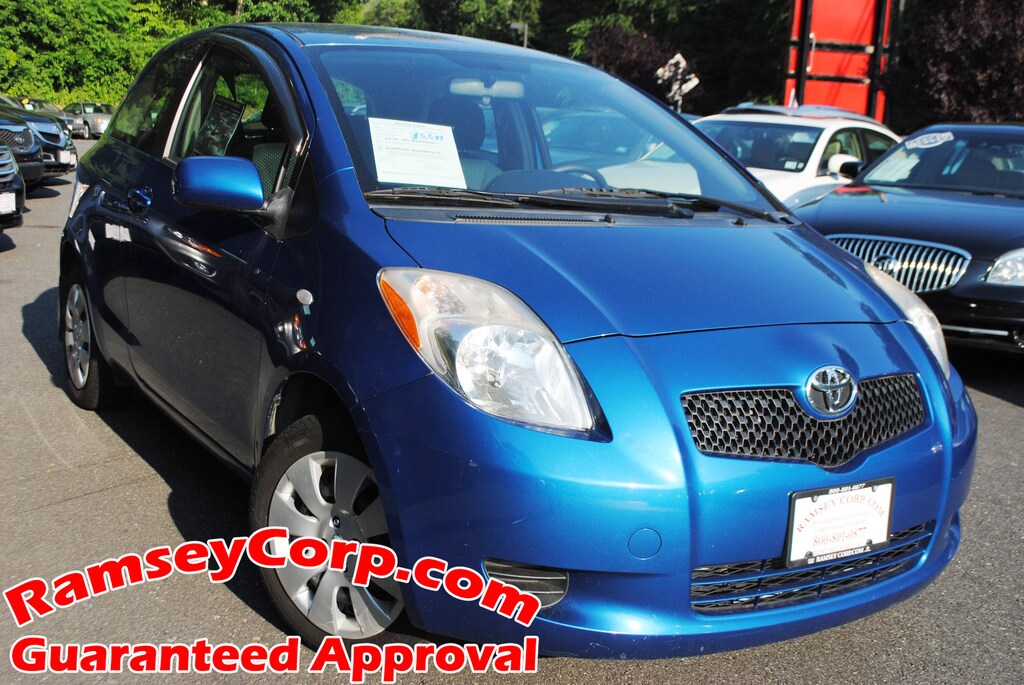
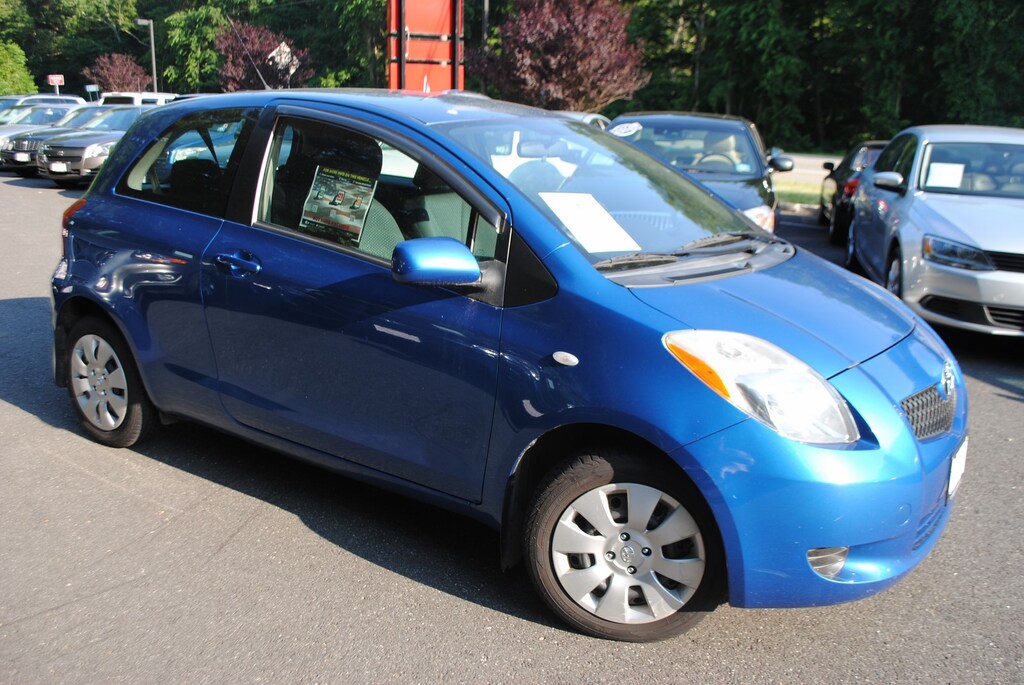
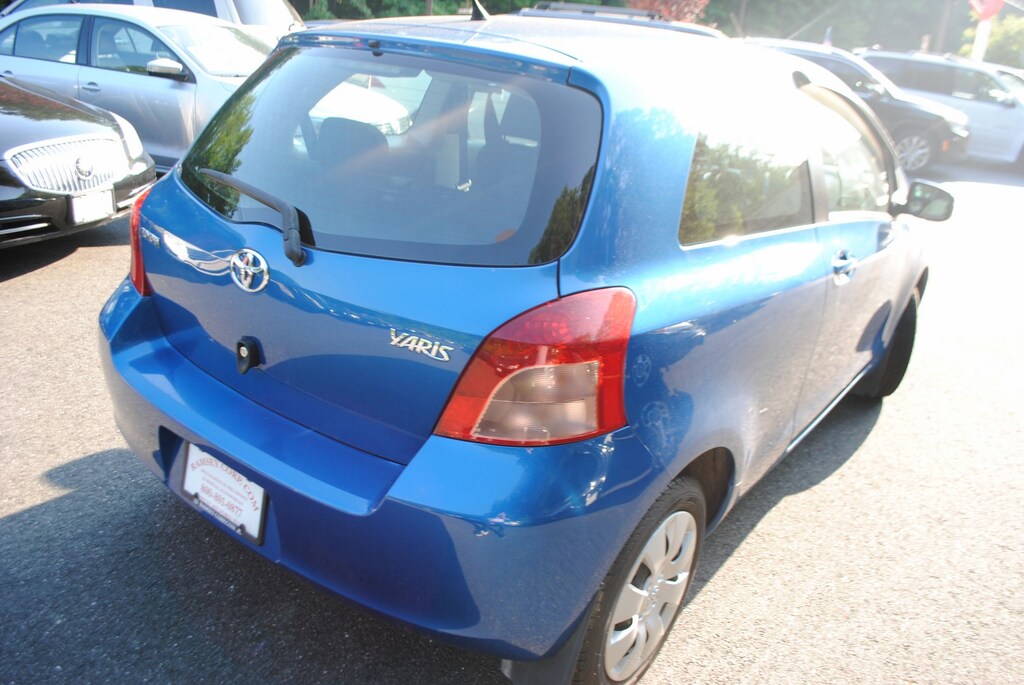


ONE OWNER
2008 TOYOTA YARIS
JTDJT923685192787
HATCHBACK 2 DR 1.5L L4 FI DOHC 16V
FRONT WHEEL DRIVE
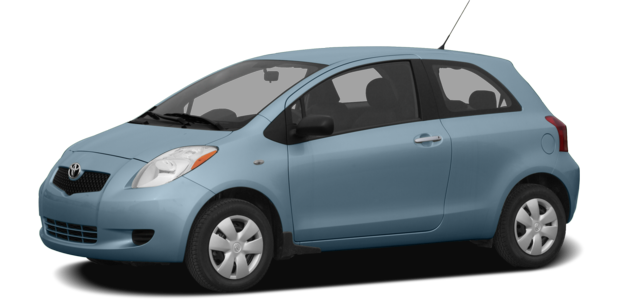
This review was written in May 2006 about the sedan version of the 2007 Toyota Yaris. Little of substance has changed with this year's model. To see what details are different this year, check out a side-by-side comparison of the two model years.
Toyota's Yaris arrives just in time to compete with several new and upgraded fuel-efficient subcompact models, filling a rejuvenated category that once appealed only to the frugal — or the broke.
The Yaris replaces the Echo, which missed the mark from the moment it hit salesrooms in 2000, appealing more to seniors than to the young drivers it was aimed at. Toyota doesn't always get it right the first time, but its models often evolve into competitive and high-selling products. After driving the sedan, it seems the Yaris is climbing Darwin's ladder, but it's not as evolved as it should be.
Exterior
The Yaris comes in two body styles: a two-door hatchback and a four-door sedan. The sedan, the basis of this review, is the more conservative-looking. Larger than the Echo, the Yaris is nearly as big as the Corolla and bears the snub-nosed look of the restyled 2007 Camry.
| Exteriors Compared | |||||
|---|---|---|---|---|---|
| Model* | Wheelbase (in.) | Length (in.) | Width (in.) | Height (in.) | Base Curb Weight (lbs.) |
| 2006 Toyota Corolla | 102.4 | 178.3 | 66.9 | 58.5 | 2,530 |
| 2007 Toyota Yaris | 100.4 | 169.3 | 66.5 | 57.5 | 2,293 |
| 2007 Chevrolet Aveo | 97.6 | 169.7 | 67.3 | 58.9 | 2,370 |
| 2007 Honda Fit Hatchback | 96.5 | 157.4 | 66.2 | 60.0 | 2,432 |
| 2006 Hyundai Accent | 98.4 | 168.5 | 66.7 | 57.9 | 2,366 |
| 2007 Nissan Versa Hatchback | 102.4 | 169.1 | 66.7 | 60.4 | 2,722 |
| *All models are sedans unless otherwise noted Source: Manufacturer data |
The base models have 14-inch wheels while the S trim level, currently for sedans only, has 15-inchers. Both are simple steel with wheel covers. Fifteen-inch alloy wheels come in some option packages. The S trim level adds side skirts and a rear air dam.
Ride & Handling
The Yaris has an independent front and semi-independent rear suspension, the normal outfit for this car class. Its ride quality is quite comfortable, especially compared to earlier econoboxes. The roadholding is decent, but there's too much body roll. This belies the Yaris' curb weight, which at 2,514 pounds (with an automatic transmission) is light, even for this class.
This is just one of the Yaris' contradictions. It's exceptionally light, yet it feels like it's throwing its weight around. It's admirably quiet at high speed — a characteristic of weightier vehicles — yet it moves through space with more of the economy car feel than some of its recently introduced competitors. Believe me, I've driven them all. If you've had the same Yaris experience, or not, post a consumer review (click on the tab above).
Going & Stopping
A 1.5-liter four-cylinder that generates 106 horsepower at 6,000 rpm and 103 pounds-feet of torque at 4,200 rpm might seem puny, but it's par for the subcompact course. It propels the flyweight Yaris to 60 mph in about 9 seconds, which is competitive, and delivers exceptional gas mileage.
| Subcompact Gas Mileage Compared | ||
|---|---|---|
| EPA-Estimated Fuel Economy (city/highway, mpg) | ||
| Model* | Manual | Automatic or CVT |
| 2006 Toyota Corolla | 32/41 | 30/38 |
| 2007 Toyota Yaris | 34/40 | 34/39 |
| 2007 Chevrolet Aveo | 27/35 | 26/34 |
| 2007 Honda Fit Hatchback | 33/38 | 31/37 |
| 2006 Hyundai Accent | 32/35 | 28/36 |
| 2007 Nissan Versa Hatchback | 30/34 | 30/36 |
| *All models are sedans unless otherwise noted |
Driving the Yaris — at least the automatic version — isn't cause for excitement. The numbers look decent, but the accelerator pedal isn't super responsive. The transmission doesn't kick down readily enough, a fault made more problematic by the fact that it has only four gears. Modestly powered four-cylinders with automatic transmissions are a worst-case scenario; if my expectations are high, it's because Toyota has proved to be better than many at building responsive four-cylinder automatics. Here? Not so much. Another gear or even a clutchless-manual mode, which I usually find pointless and silly, would help. The manual is likely a different situation altogether. In fairness, I haven't driven an automatic Honda Fit yet.
As for the braking, the hardware is what you'll find in almost all subcompacts: power front-disc and rear-drum brakes. They definitely do the job, but I'm disappointed by the mushy, numb pedal. Four-wheel ABS is a $300 stand-alone option.
The Inside
The Yaris' interior is perhaps the least evolved aspect, post-Echo. The materials quality is improved, and the faux-aluminum plastic isn't the worst I've seen, even when compared to more expensive cars. Overall, it's not the best Toyota could do.
The instrument panel is still in the center of the dashboard, a location that has garnered a level of disdain nearing violence for both the Echo and the Saturn Ion. One of the reasons for this approach is that it is simpler and cheaper for automakers to make both left- and right-hand-drive versions for different global markets. Still, I'm astounded it wasn't changed. I'm one of the few people who didn't mind this placement because I often find that the steering wheel blocks my view of the instruments, but Honda has proven in the Civic that gauges can live high and forward, above the steering wheel.
The parade of ergonomic bungles continues. While the driver's seat has the very important height adjustment, complete with the easily operated ratcheting lever, the cushion is shorter than it should be, and I couldn't get as far as desired from the pedals without getting too far from the steering wheel. Not all drivers are 6 feet tall, but I haven't had that problem in other subcompacts — even though none have a telescope adjustment for the steering wheel.
Then there's the pedals, which I found to be peculiarly close together despite a roomy footwell, with the accelerator pedal practically touching the bulkhead to its right — definitely closer to a barrier than any I've experienced before. Could this be another casualty of a bias toward right-hand drive? A chance mutation? A conspiracy to make this the bitchiest review ever?
The cupholders and storage provisions are all quirky yet functional. Included in my test vehicle's optional Power Package is a handy auxiliary audio input for MP3 players and the like. It's strange that it's tucked into a storage bin on the right-hand side of the center control panel, where it would best be reached by the passenger ... or the driver in a Japanese model. Oh, now they're just trying to tick me off.
| Interiors Compared | |||||
|---|---|---|---|---|---|
| Model* | Headroom (front/rear, in.) | Legroom (front/rear, in.) | Shoulder Room (front/rear, in.) | Hip Room (front/rear, in.) | Passenger Volume (cu. ft.) |
| 2006 Toyota Corolla | 39.3/37.1 | 41.3/35.4 | 53.1/53.5 | 51.9/46.2 | 90.3 |
| 2007 Toyota Yaris | 38.8/36.7 | 42.2/35.6 | 51.6/50.2 | 49.8/50.1 | 87.1 |
| 2007 Chevrolet Aveo | 39.3/37.4 | 41.3/35.4 | 53.6/52.8 | 51.4/52.7 | 90.7 |
| 2007 Honda Fit Hatchback | 40.6/38.6 | 41.9/33.7 | 52.8/50.6 | 51.2/51.0 | 90.1 |
| 2006 Hyundai Accent | 39.6/37.8 | 42.8/34.3 | 53.5/53.1 | 50.6/49.6 | 92.2 |
| 2007 Nissan Versa Hatchback | 40.6/38.3 | 41.4/38.0 | 53.5/50.7 | na | 94.4 |
| *All models are sedans unless otherwise noted na = not available Source: Manufacturer data |
Safety
The Yaris hasn't been crash tested, but as far as the safety features go, dual-stage front airbags are standard. In fact, they are required in all new models. Side-impact airbags for the front seats are available with side curtain airbags in a $650 option. Antilock brakes are optional.
Cargo & Towing
The Yaris sedan has the expected cargo provisions: a reasonably sized trunk and a 60/40-split, folding backseat that extends the cargo space into the cabin. Folding the seats is a one-step process involving release knobs atop the backrests. The center shoulder belt crosses the opening, but it can be detached at the seat and stored in its retractor. Note in the photos that the opening into the cabin is small relative to the trunk's width, which is nothing new for Toyota. Some of the 2007 Camry's trim levels have no folding-seat feature, and those that do also have a smaller opening than do many competitors.
The Yaris shares the modesty common to this car class in the form of simple trunklid hinges that descend into the cargo space, and a trunk release that sits on the floor in the driver's footwell. There's no release on the optional remote keyless entry. The key must be used when opening the trunk from the outside.
Features
No features are glaringly absent from the Yaris. Increasingly the norm in this class, air conditioning is standard. While standard power windows remain uncommon, power locks increasingly are beginning to be included in this class. The Yaris includes them in an option package along with power windows. Toyota's archrival, Honda, includes both items standard in the Fit, along with some high-value safety features.
Yaris in the Market
It's probably obvious that my overall reaction to the Yaris is one of disappointment. It's easy to hold up the Fit as a new standard. The issue here is that Toyota, the maker of such class leaders as the Camry and Sienna minivan, isn't leading anyone in this class. The Hyundai Accent is tough competition, as are the Kia Rio and Chevy Aveo. Toyota has pulled something of a GM here: It has improved markedly over its own previous product but allowed the competition to move the benchmark with which the Yaris seems intended to compete. All-new models and complete redesigns are a manufacturer's opportunity to make major changes and improvements. Not taking advantage may mean years of stagnancy as the competition evolves further — and faster.
The car market is like the wild kingdom, where the fittest survive. If the environment becomes more hostile because of higher gas prices, the Yaris may have the attributes to keep it strong. But if the survival challenges are broader and more varied, the more evolved species available could very well eat it alive