
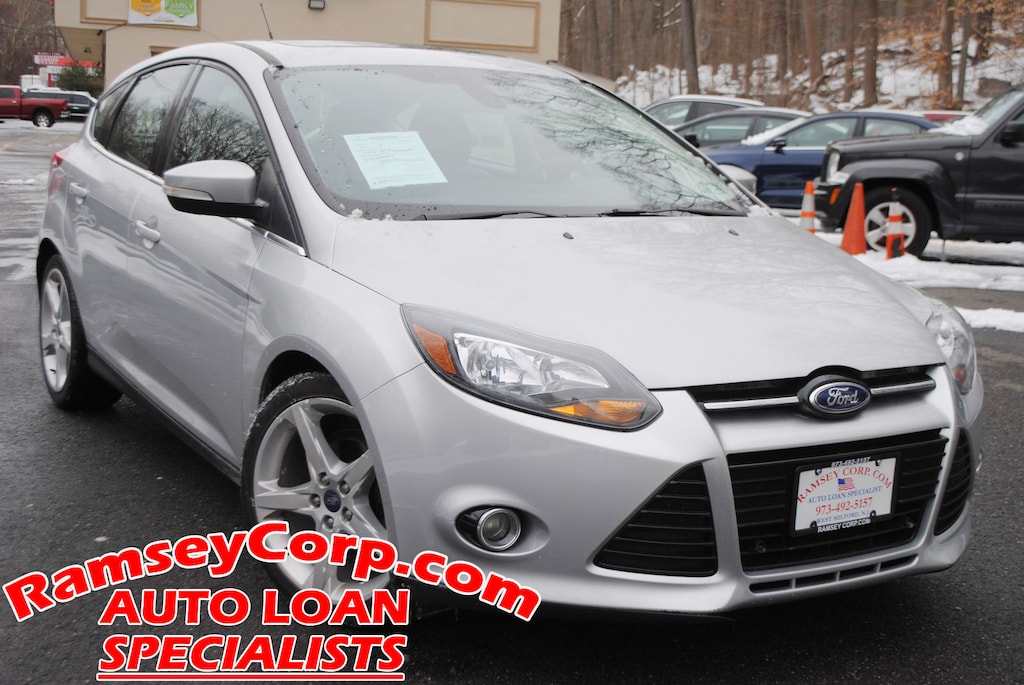
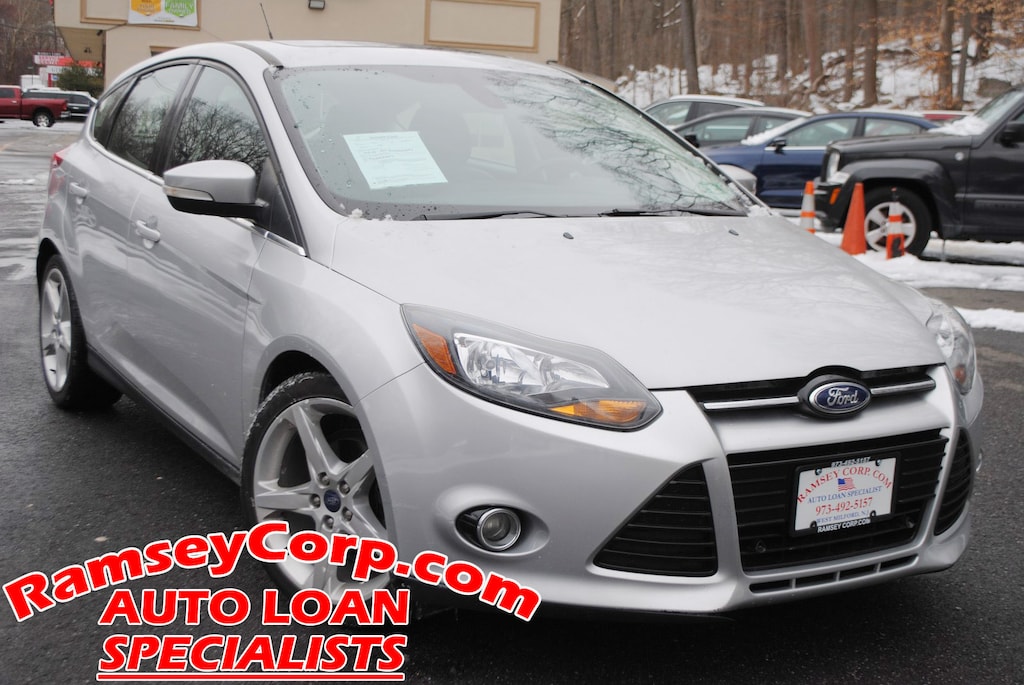
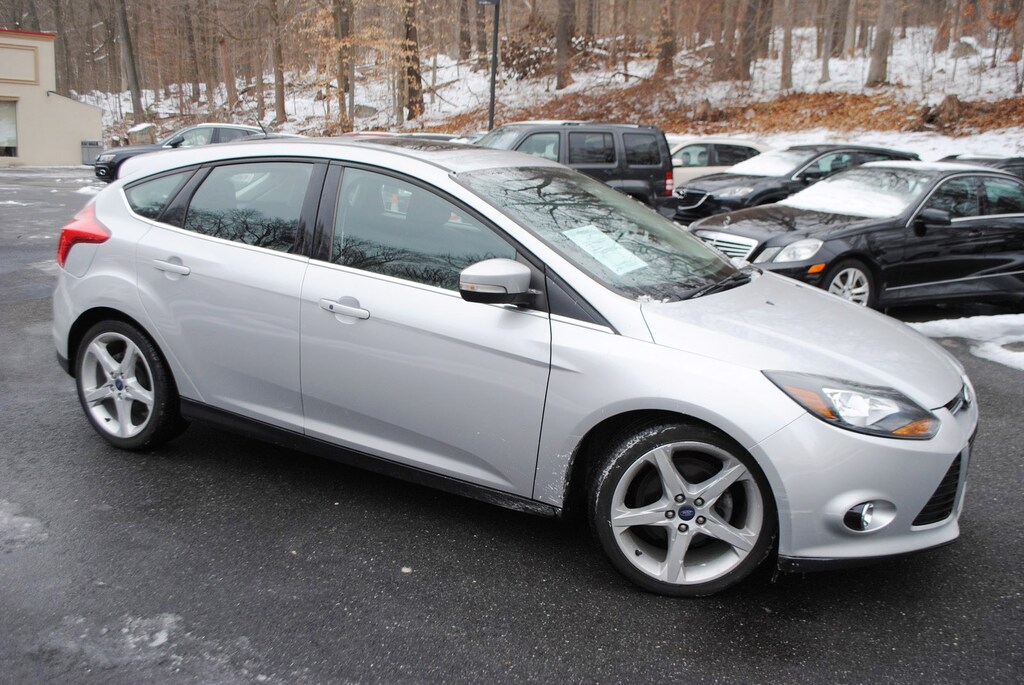
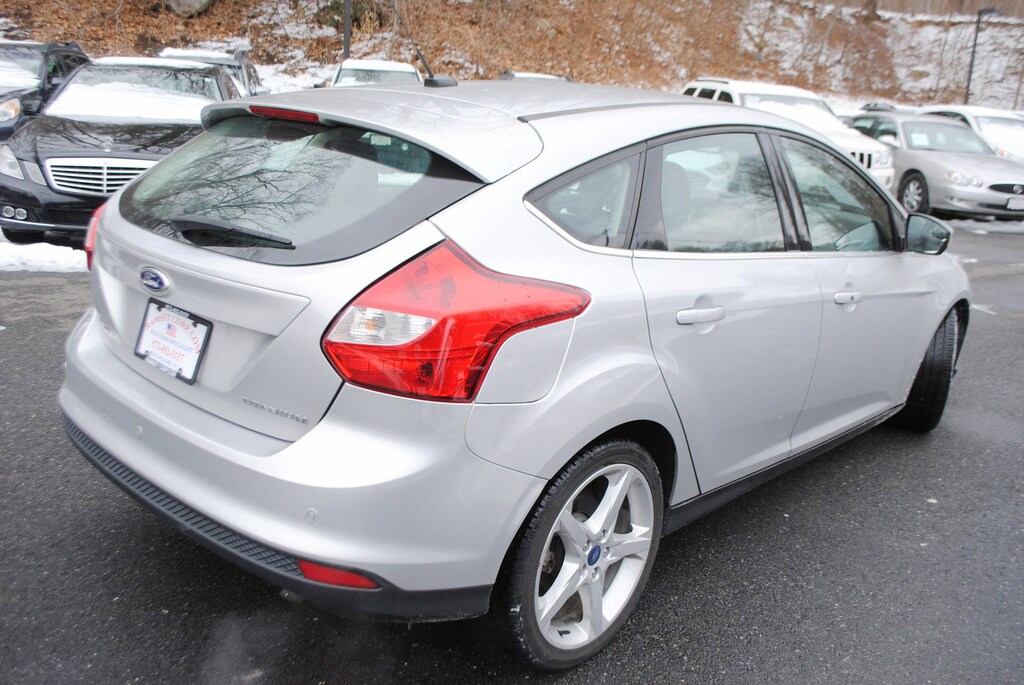


RAMSEY CORP IS HOME OF GUARANTEED CREDIT APPROVAL! THIS VEHICLE COMES WITH A FREE 3 MONTH WARRANTY; EXTENDED WARRANTIES AVAILABLE. FAMILY OWNED, NO COMMISSION SALES, NATIONWIDE SHIPPING RATES
Leather / Heated Seating
Navigation
Sunroof
2012 FORD FOCUS TITANIUM
1FAHP3N26CL442445
HATCHBACK 4 DR
2.0L I4 F DOHC 16V
FRONT WHEEL DRIVE

With better styling than the Chevrolet Cruze and better handling than the Hyundai Elantra, the 2012 Ford Focus is the most complete package in the compact-car market.
The Focus name isn't new to the U.S., but the 2012 model is the first Focus to be shared among the U.S., Europe and the rest of the world. In Europe, compact cars are a staple, and buyers shell out thousands of dollars (or dollar equivalents) more for them than we do. Now, we're finally getting the quality formerly enjoyed only overseas, and you can see, feel and hear it in the 2012 Focus.
The 2012 Ford Focus is stylish in both sedan and four-door-hatchback body styles. The sedan comes in an entry-level S trim level, and both the sedan and hatch come in SE, SEL and Titanium trims. For a trim-level comparison, check out the sedan and hatchback. A high-performance Focus ST will join the family, but not until next year.
The Finest Attribute
The Focus offers two suspension tunings, tied to wheel size. A more compliant but still lively setup accompanies all wheel sizes from 15 to 17 inches. The largest wheels, 18-inchers that are optional on the Titanium trim, come with a firmer, sportier suspension. (As we publish this review, both Ford's website and our own data show an optional suspension for the SE trim level; this is incorrect and will be revised.) Even the sportier suspension was agreeable on the mostly healthy road surfaces in and around Los Angeles. Equipped with optional summer tires, the Focus Titanium sedan with 18-inch wheels crossed highway expansion joints with a faint thrumming sound that recalled earlier, lighter Audis — a sensation I always associated with an exceptionally stiff body structure. Overall, the Focus is admirably quiet in all regards.
It was on canyon roads that the Focus showed its finest attribute: handling. I can't say I'm surprised, because the previous-generation Ford Focus' dynamics were underrated — or perhaps just underreported. The car flew under the radar because it was so poised and natural in the twisties that you didn't realize how good it was unless you looked at the speedometer. The 2012 Focus takes it up a notch. More like three notches, actually.
Naturally, the Titanium sedan with the 18-inch wheels and sport suspension was the more capable; its Michelin Pilot Sport 3 summer performance tires (rated P235/40ZR18) gave up traction reluctantly, to say the least, with the faintest of chirps. (At an estimated replacement cost of $250 apiece, I'd expect nothing less.)
But I don't want to downplay the capabilities of the lower trim levels, such as the Focus SE hatchback with 16-inch all-season tires. It, too, exhibited surprising control and athleticism, eager to dive into corners and then claw its way back out. Ford attributes this in part to a standard torque-vectoring feature that uses the traction control to brake the inside wheel when accelerating out of a turn, allowing the power to drive the outside wheel and maintain a tighter line.
In a sense, traction control does this already when accelerating on low-traction surfaces, but Ford characterizes torque vectoring as a predictive action. Similar to a feature Porsche employs, torque vectoring is a subtle action that goes undetected, rather than a reactive intervention by the traction control or electronic stability system.
As in the previous Focus, steering is a high point, with good feedback and a propensity to snap back to center after a turn. It's good to get this performance after a switch to electric power steering. Ford wasn't the first to adopt the technology, but its execution has proved to be among the very best. The Focus exhibits some torque steer under heavy acceleration once it gets going, but it's an amount I can live with — especially because automakers usually eliminate torque steer by eliminating torque.
The Ford Focus reminds you how satisfying a well-engineered front-wheel-drive car can be. I'd have to drive them back-to-back to know for sure, but I suspect the new Focus has the Cruze beat. I'll say the same about the Mazda3, though the Mazda might still hold the edge in steering feel, having adopted electro-hydraulic steering rather than going to full electric, a half-step that comes at the cost of fuel efficiency.
Power to Satisfy But Not Impress
Where the Focus is likely to satisfy more than impress is in acceleration. We found the subcompact Fiesta to be modestly powered at best, with the six-speed PowerShift automatic preferable over the five-speed manual. The Focus is a similar story, though its power is more satisfying than the Fiesta's. Part of the issue is perceived power, because the direct-injection 2.0-liter four-cylinder delivers its peak torque of 146 pounds-feet at a relatively high 4,450 rpm. The ratios of the 5-speed manual transmission's lower gears are relatively tall, making for a leisurely launch. Though the six-speed automated manual has shorter starting gears, it still moseys off the line for the first several meters. The gearbox attempts to make up for it once you get moving, transferring the engine's generous 160 horsepower with split-second upshifts and efficient operation. If memory serves, the Cruze is quicker from a standstill with its conventional automatic transmission and a turbocharged 1.4-liter engine that delivers its 148 pounds-feet of torque at 1,850 rpm.
Once theFord Focus is in motion, the responsiveness is more satisfying, though higher revs are the only way to go. The best way to achieve this is in the Sport mode, which you activate by pulling the gear selector back from the D to the S position. Here, it gladly holds the engine at higher rpm and kicks down more readily when you jab the accelerator. It's especially good at reading a quick release and downshifting a gear on the assumption that you're entering a corner or cresting a hill and want the control and on-demand torque of higher revs. For an expensive technology on an affordable car, PowerShift is impressive.
Less impressive is the manual-shift feature, which Ford calls SelectShift. Once you're in Sport mode, a rocker switch on the shift lever marked "+/-" can override the automatic operation and allow manual shifting. The main problem is how awkward it is to reach this control once the shifter is in its rearmost position. I'm not the biggest fan of this type of feature, nor of the steering-wheel-mounted shift paddles it usually employs, but if Ford's going to offer it, paddles would be preferable to the switch.
Ford is yet another automaker to boast highway mileage of "up to" 40 mpg, along with the Cruze and Hyundai Elantra, but the top mileage comes only with the Super Fuel Economy option, similar to the Fiesta's. Final EPA ratings haven't been released yet. SFE won't be available as of the model's launch, but it will include low-rolling-resistance tires, a rear spoiler and an active grille shutter system, which automatically controls vanes in the grille based on speed and temperature, opening them only as far as necessary to cool the engine. Ford says aerodynamics improve as they close, raising efficiency by as much as 4 to 5 percent at cruising speed.
The SFE Focus compares to the Cruze Eco, which is the high-mileage version of Chevy's compact car. While the Eco is a trim level all its own, SFE is a $495 option package available on the second-lowest Focus sedan trim level, the SE with an automatic transmission. The total price comes to $19,585, including the destination charge. The Cruze Eco's most efficient version is manual and costs $18,895, but the automatic version costs $20,345 and sacrifices some mileage versus the manual (final EPA numbers aren't available). Hyundai says all versions of the Elantra will achieve 40 mpg without special options, at a base price below $16,000.
In the Cabin
At 91 cubic feet of passenger volume, the Focus is a bit smaller inside than the 2011 model, which measured 93 cubic feet. This puts it in league with older-school compacts like the 2011 Honda Civic and Toyota Corolla at 91 and 92 cubic feet. The other recent redesigns have taken the opportunity to grow, with the Cruze, Elantra and Volkswagen Jetta boasting 95, 96 and 94 cubic feet, respectively.
I still found the Ford Focus' front seats workable, and I appreciated the standard driver's seat height adjustment and tilt/telescoping steering wheel. By the numbers, the Focus has 38.3 inches of front headroom versus the Cruze's 39.3 and the Elantra's 40.0 inches. The Focus sedan and hatchback have identical dimensions except for backseat headroom, which is a fraction of an inch less in the hatchback. Regardless, this dimension beats or exceeds the competitors. Backseat legroom is on the low side, at 33.2 inches. The Elantra's measures 33.1 inches, but the Cruze, Corolla and Jetta come in at 35.4, 36.3 and 38.1 inches. At 6 feet tall, I was able to sit in the backseat only if the front occupant gave up a significant slice of the legroom pie.
Cargo space is a similar story, with the Focus sedan's 13.2-cubic-foot trunk besting the Civic and Corolla but falling behind the Cruze, Elantra and Jetta's 15.4, 14.8 and 15.5 cubic feet. Buyers who want more space and versatility should consider the Focus five-door hatchback, which offers 23.8 cubic feet behind the backseat and a total of 44.8 cubic feet when the rear seats are folded flat. A folding backseat is standard, but it's a one-piece until you get to the Ford Focus SEL trim level, where it's split 60/40 and includes a fold-down center armrest.
Rear visibility is quite good, and a backup camera is an option, along with MyFord Touch. I'm a bit more concerned about the forward view. For more than half of the Focus' body structure, Ford uses boron and other high-strength steels that require less material and lower weight than conventional metals. All the same, the A-pillars are relatively thick, and they're far enough forward that the left one obstructs one's view, especially when navigating curvier roads. When the desires for better aerodynamics and stronger roofs meet, you end up with thick windshield frames that emerge from farther forward on the hood.
The Ford Focus has the now-requisite low-gloss, soft-touch surfaces where they matter most, and many high-quality materials. I wouldn't put it ahead of the Cruze, however, partly because of my personal disdain for silvery plastic, which is in ample supply in the Focus, in various shades. The chrome and faux aluminum on the steering wheel work pretty well; the center control panel and other accents, not so much. There's a little piano-black trim on models with MyFord Touch, which I prefer, but it's minimal. (For the record, I don't think the gloss black has any higher monetary value than the faux metals; I just think the latter look cheap and have outstayed their welcome in car interiors.)
Sync, MyFord and MyFord Touch
Ford has been a leader in vehicle computerization, and the results have been mixed. Sync, developed with Microsoft, is mainly about voice-activation, entertainment-system control and some telematics features like those offered by GM's OnStar. Sync is not available on the S trim level, but it's optional on the SE and standard on the SEL and Titanium. Now, you control these features through one of two "driver connect" systems: MyFord and MyFord Touch. (If you think the designations are confusing, wait until you use the systems themselves.)
MyFord, the simpler system, employs two 4-inch color displays — one between the gauges and one high in the center of the dashboard. Steering-wheel and dashboard buttons are the way you access the Sync voice activation and the various features. MyFord Touch replaces the dashboard display with an 8-inch touch-screen, on which we report in other Ford model reviews. MFT is standard on the Focus Titanium.
You could fill a seminar on how to use MyFord Touch, so I'll just highlight what's good and bad about it. What's good is that it attempts to integrate capabilities in a safe manner — activities consumers are likely to engage in with their smartphones anyway. What's good about the Focus' implementation is it has real buttons and knobs, unlike the Edge and Explorer crossovers, which use varying degrees of touch-sensitive panels. The Ford Focus looks like it has a multifunction controller knob, but that's just a simple audio system control for volume, track skip, etc. The voice recognition keeps getting more reliable, and that's good. I especially like the two star keys on the Focus' steering wheel, which can be customized to do any number of things. A favorites screen in MFT stores up to 22 shortcuts of your choosing, and two of them can be assigned to the star buttons — anything from your favorite destinations to audio commands, like browse or shuffle. MFT also provides wireless internet to anyone in your Focus if you plug a 3G wireless transceiver into one of the two USB ports.
What's bad about MFT are mainly the simplest things: unacceptable delays when you hit a button, quirks with the voice activation, buggy operation and the fact that too much is often jammed onto a single screen. It's a bit of a drag in competing systems to have to jump from one page to another, but there's a reason for it: You can read it at a glance. The Ford approach might save you some screen-touching, but squinting at tiny type is a distraction in its own right.
A problem with Sync itself, in my opinion, is an over-reliance on voice activation. No matter how sophisticated and accurate it becomes, it's just not how I want to control my car's features, partly because I don't find it as quick or efficient as hitting a button or two. That's where MFT comes in: For all its ills, it's still a touch-screen, and for that I'm grateful. The system can and will be improved and updated, and owners will be able to upgrade their interfaces just as you can with computer software. The overall premise is a good one: small displays in each corner of the screen give you minimal information, and all you have to do is push on it to call up that full screen. It's easy to target these corners even in a moving car. You may recall that the multifunction controllers championed by German luxury brands were a disaster initially but have evolved to become quite usable — if inferior, in my opinion — to the touch-screen approach. I'm not prepared to give up on MFT, so long as Ford reverts to regular physical buttons as they have on the Focus.
Safety
A newly re-engineered model, the 2012 Focus has yet to be crash-tested by the Insurance Institute for Highway Safety and the National Highway Traffic Safety Administration.
As required of all 2012 models, the Ford Focus includes antilock brakes, traction control and an electronic stability system.
The Focus marks the debut of new airbag technology that Ford says will better protect against chest and rib injuries. Both the shape and a new variable venting feature attempt to tailor airbag deployment to suit the occupant's position. Seat-mounted side-impact airbags also have shoulder-level vents that are blocked by taller occupants to maximize deployment force; shorter occupants allow more venting and thus encounter a lesser force consistent with their size. Curtain airbags that cover the side windows for both rows of seats are also standard. For a full list of safety features, click here.
Focus in the Market
The Ford Focus has the makings of a runaway hit. It's a bit smaller inside than its recently released competitors, but is otherwise a well-rounded package, with styling challenged only by the Elantra and dynamics that can take on anything in the compact class. Though the S and SE trim levels hold the line on price, the other trims are a significant price jump over 2011. With the redesign and recent introduction of the Fiesta subcompact, this is what we'd expected. In terms of features, the Ford Focus can't come close to Hyundai's value proposition, but it does offer things the Elantra doesn't, such as automatic parking. It also has MyFord Touch; whether that's a good thing or not is for you to decide.