



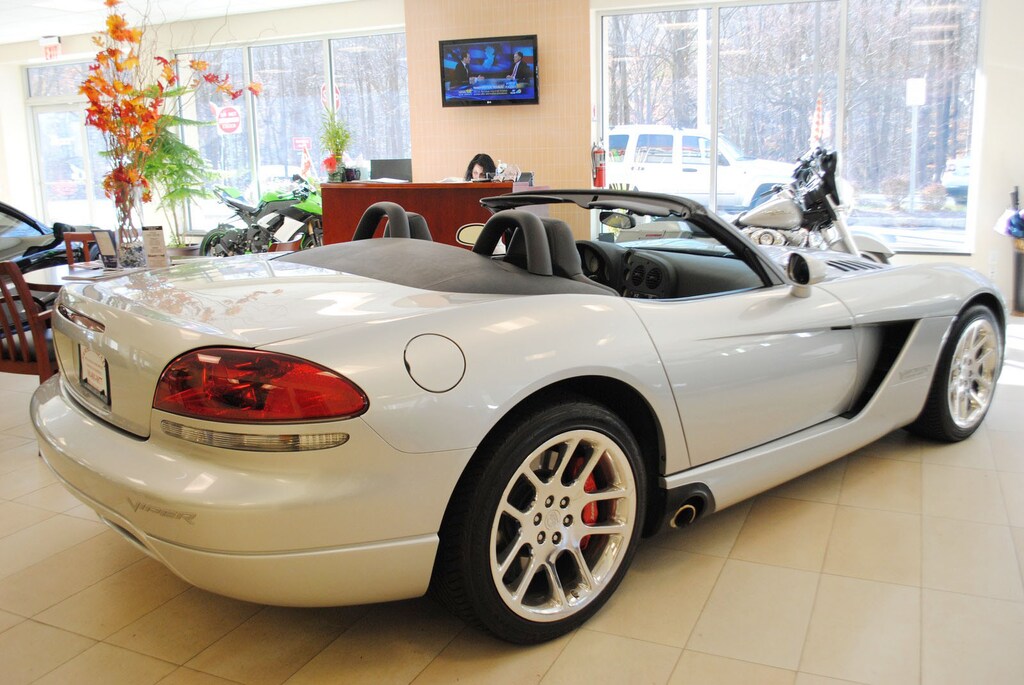


Leather / Heated Seating
Alpine Premium Sound System
Xenon Headlamps
6-CD Changer
6-SPD
2004 DODGE VIPER SRT-10
1B3JZ65Z94V101908
CONVERTIBLE 8.3L V10 SFI
REAR WHEEL DRIVE
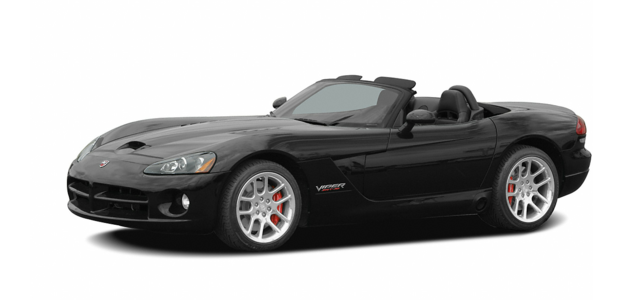
Vehicle Overview
A new, hotter-than-ever edition of Dodge’s supercar went on sale as a 2003 model. It still promises “raw performance,” but the current model is lighter and faster. The Viper SRT-10 represents “obscene performance, outrageous design and ultimate driver enjoyment,” said Jim Julow, vice president of the Dodge Global Brand Center.
The Viper SRT-10’s all-aluminum V-10 engine grew from 488 to 505 cubic inches — 8.3 liters — in displacement, yielding 500 horsepower and 525 pounds-feet of torque. These figures almost make the previous V-10 engine’s 450 hp sound puny. A six-speed-manual transmission sends all that force to 19-inch rear tires. The racing-style chassis incorporates a fully independent suspension and massive brakes.
Carpeting for the trunk is new for 2004, and the brake calipers are now painted red. Viper White is a new body color, and a folding tonneau cover is standard.
Unlike the previous Viper, which came in roadster and closed-coupe forms, the current model is produced only as a two-passenger convertible. It’s a true convertible, which should please buyers who’ve had first-hand experience with the balky soft roof on earlier Vipers. More than any other model on the market, the Viper SRT-10 represents serious, traditional, American performance centered on a big engine and a lack of frills. Even so, today’s Detroit-built Vipers can be equipped with a number of comfort and convenience features.
Loosely patterned after the Shelby Cobras of the 1960s and the Chrysler Hemi-powered Cunningham racers of the 1950s, the first Viper went on sale as a 1992 model.
Exterior
Vipers have flaunted their wild and untamed nature from the beginning, and the current version continues that trend. Styling cues for the 2003 model were taken from the Viper GTS/R concept car unveiled at the 2000 North American International Auto Show. Swept-back fenders, deep-cut side scallops and lowered hood lines resemble the styling cues of the original Viper but give the low-slung roadster a more modern appearance. Dodge installed a belly pan as one of several steps to improve the Viper’s aerodynamics.
The Viper SRT-10’s fabric roof has a fresh profile, but it doesn’t lose the original’s roadster feel. Using a single center latch, the bifold clamshell top is said to operate easily for open-air driving. The front tires measure 18 inches in diameter, while P345/30ZR19 rear tires are mounted on forged-aluminum wheels that are 13 inches wide. The new-generation Viper SRT-10 stretches 175.6 inches long overall, rides a 98.8-inch wheelbase and stands 47.6 inches tall.
Interior
Inside the two-passenger racing-derived cockpit, the driver starts the V-10 engine via a push-button and sits before a 220-mph speedometer and a center-mounted tachometer. Dodge vows that the Viper SRT-10’s interior will fit drivers like a glove, calling it “the automotive equivalent of a jet fighter.”
Under the Hood
The Viper’s 8.3-liter V-10 engine generates 500 hp and 525 pounds-feet of torque. A six-speed-manual gearbox is the sole transmission offering.
Safety
Antilock brakes are standard, but side-impact airbags are not available.